
When Sport Is Everything: What Teenage Athlete Mental Health Really Looks Like

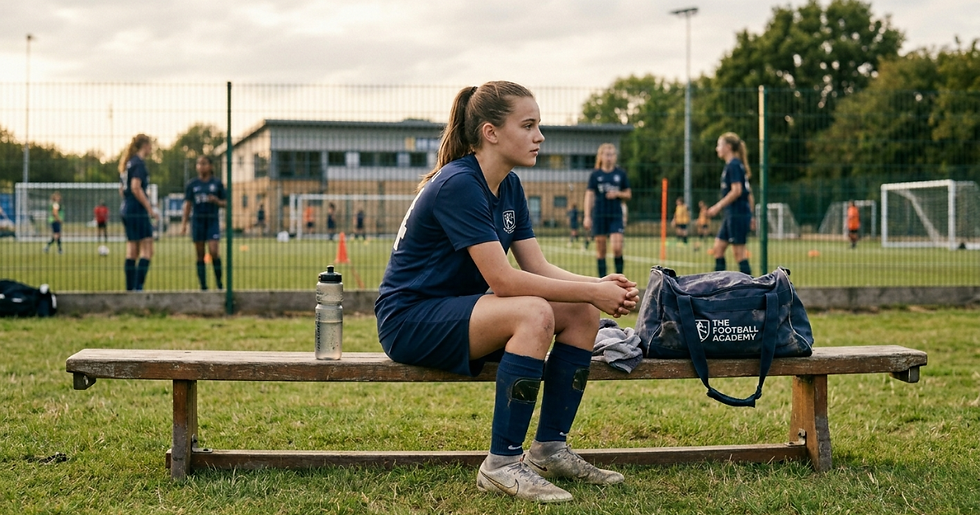
There is a particular kind of quiet that settles over a sporting child when they are injured. Not the quiet of rest, but the quiet of displacement. The training schedule that has structured their week since primary school suddenly stops. The group chat carries on without them. The identity they have spent years building, through early mornings, cold pitches, and the particular language of their sport, has nowhere to go.
This is the moment many parents bring their child to coaching. Not always immediately, and not always naming it as a crisis. More often, they describe something more subtle: their son has become withdrawn and snappy, or their daughter has lost her appetite for things that used to matter. The sport isn't the problem, they say. But somehow, everything feels connected to it.
They are right. And new research is beginning to explain why.
Why Teenage Athlete Mental Health Deserves More Attention
In January 2026, researchers at the Podium Institute for Sports Medicine and Technology at the University of Oxford published the first systematic review to quantify the two-way relationship between sports injuries and mental health in young people. Drawing on data from over 221,000 athletes aged 10 to 24, the findings were clear: young people with poor mental health are at greater risk of injury, experience more severe injuries, and take significantly longer to recover. At the same time, sustaining an injury increases the risk of mental health difficulties.
This is not a one-directional problem. It is a loop. And for teenagers whose sense of self is deeply tied to their sport, it can become a particularly difficult one to step out of.
Separate research, published by the University of Bath in collaboration with Podium Analytics, is now actively exploring how sports injuries affect young people's self-identity and psychological wellbeing. The researchers note that while the physical aspects of recovery are well-documented, the emotional and psychological impact on young athletes has been largely overlooked. What they are finding points to something coaches and parents who work closely with young athletes already know intuitively: that injury doesn't just sideline a body. It can sideline a sense of self.
The Identity Question
For many young people at independent schools who train seriously in sport, the athletic identity isn't one part of who they are. It is the dominant part. It is how they introduce themselves. It is what earns them respect in their peer group. It is, often, the lens through which they understand their own worth.
This is not a problem in itself. A strong athletic identity can be a genuine source of strength, providing structure, purpose, community, and resilience. The difficulty arises when that identity is the only lens available. When a young person has no strong sense of who they are outside their sport, then anything that threatens the sport, whether injury, a dip in form, the end of a season, or not making a squad, threatens everything.
I see this most often in young people who have specialised early and trained intensively through their prep and senior school years. By the time they are 14 or 15, sport has shaped their friendships, their timetable, their family dynamics, and their self-image. It is genuinely central to their life. The adults around them, including parents, celebrate this commitment. And it is worth celebrating. But it is also worth asking, alongside the celebration: who is my child when they are not competing?
That is not a threatening question. It is a protective one.
What Parents Often Notice First
Most parents don't arrive at the conversation about teenage athlete mental health with a clinical vocabulary. They arrive with a feeling: something is off, and I can't quite name it.
What they describe, in coaching sessions and in conversations with schools, tends to fall into a few recognisable patterns.
The first is perfectionism that has migrated from performance into everything else. The young person who couldn't tolerate a mistake on the pitch begins to struggle to tolerate any mistake at all. Schoolwork, friendships, and family relationships all become subject to the same relentless internal standard. A less-than-perfect test result becomes devastating. A misunderstood comment from a friend becomes a reason to withdraw entirely.
The second is difficulty with rest. High-performing young athletes are often praised for their work ethic, and rightly so. But when the capacity to rest or play without purpose disappears entirely, that is a sign that performance has become the only mode available to them. Parents notice this during the holidays. Their child cannot stop. The absence of structure or competition brings anxiety, not relief.
The third is a particular vulnerability that comes with injury or enforced time out. Research consistently shows that injury is one of the highest risk factors for depression among young athletes. When a teenager's primary source of identity, community, and self-regulation is suddenly removed, the psychological impact can be significant and swift.
How Coaching Supports Teenage Athlete Mental Health
Positive psychology coaching offers something distinct from both counselling, therapy and sports psychology, and it is worth being clear about those distinctions.
Sports psychology focuses specifically on optimising athletic performance: concentration, motivation, mental preparation, and the psychological skills that help a young person compete at their best. That work is valuable, and for serious athletes it can be transformative. Coaching sits in a slightly different space. Rather than targeting sport performance or treating difficulty, it works with the whole person, helping young people develop the broader psychological foundations that make them more robust, more flexible, and more fully themselves, on and off the pitch.
In practice, with young athletes, that often means working on identity breadth. Helping a young person to recognise and articulate who they are beyond their sport, not as a replacement for that identity, but as an extension of it. The process is curious and collaborative, not prescriptive. It begins with questions rather than answers.
It also means working on what positive psychologists call character strengths: the qualities that belong to the person, not to their performance. A young person who identifies their strengths as courage, fairness, and curiosity has something to stand on when their sport cannot hold them for a while. Those qualities don't disappear when they are injured. They remain available, and coaching helps them see that.
We also work with young athletes on resilience and their relationship with failure and uncertainty. Two things that competitive sport offers in abundance, but which the high-achievement culture of many independent schools treats as things to be avoided at all costs. A young person who can hold both the desire to win and the capacity to lose without it defining them is more resilient, more enjoyable to be around, and, as the research suggests, physically safer too.
What Parents Can Do
The most important thing parents can do is begin the conversation about identity before it becomes urgent. Not during an injury or a crisis, but in the ordinary moments of a training week. What do you love about this sport? What would you do if you couldn't do it for a while? Who are you on the days you are not competing?
These questions don't undermine commitment. They deepen it. A young person who has thought about these things is better placed to absorb the inevitable setbacks of competitive sport than one for whom the question has never been raised.
It is also worth being attentive to the language used at home around sport. Praise that is exclusively about outcomes, results, times, scores, and selections teaches children that those outcomes are what they are valued for. Praise that notices effort, attitude, growth, and character builds a different kind of foundation, one that holds when the results are harder to come by.
And if something feels wrong, trust that feeling. Parents of young athletes are often remarkably perceptive. The withdrawal, the irritability, the loss of joy in something that used to bring so much: these matter. They are worth a conversation, and if that conversation is hard to start at home, coaching can offer a neutral, supportive space where a young person can begin to put words to what they are carrying.
Frequently Asked Questions About Teenage Athlete Mental Health
What are the signs that my teenage athlete's mental health is suffering?
The signs are often behavioural rather than verbal. A young person who is struggling may become withdrawn from friends and family, lose interest in things outside their sport, show increased irritability or emotional volatility, have difficulty sleeping, or experience a noticeable drop in motivation and enjoyment. Following an injury, watch for low mood that persists beyond the first week or two of recovery, reluctance to engage in rehabilitation, or a general flatness that feels different from ordinary disappointment. Young athletes are often less likely than their peers to ask for help directly, so the adults around them need to be proactive in checking in.
Is it normal for a teenager to base their whole identity on their sport?
It is common, especially among young people who have trained seriously from a young age. Having a strong athletic identity is not inherently harmful. It provides structure, purpose, and belonging. The difficulty arises when it becomes the only source of self-worth, leaving a young person without a stable sense of who they are when sport is not available. Positive psychology coaching can help young athletes develop what researchers call identity breadth, so that the sporting identity sits alongside, rather than on top of, everything else.
How is coaching different from therapy for a young athlete?
Coaching and therapy serve different purposes, and both have an important place. Therapy is appropriate when a young person is experiencing diagnosed mental health difficulties and needs clinical support. Coaching works with young people who are essentially well but want to develop greater psychological resilience, a broader sense of identity, better management of pressure and performance anxiety, and stronger wellbeing foundations. Many young athletes benefit from coaching as a preventative resource, building the inner resources that help them navigate the inevitable challenges of competitive sport before those challenges become a crisis.
My child's sport takes up most of their time. How can I encourage a broader sense of identity without them thinking I don't support their sport?
This is one of the most common concerns parents bring to parent coaching, and it is a thoughtful one. The key is framing. Questions about identity and life outside sport don't have to signal a lack of confidence in a young person's sporting future. They can simply be expressions of genuine curiosity about who your child is as a whole person. Noticing and naming strengths that show up outside sport, whether creativity, humour, empathy, or intellectual curiosity, communicates that you see all of them, not just the athlete. That kind of recognition is deeply sustaining for a young person under pressure.
What age is appropriate to start coaching for a young athlete?
We work with young people from the age of 8 upwards. In practice, coaching tends to be most impactful when it begins before a crisis rather than during one. Young people who come to coaching with broadly intact wellbeing and a willingness to reflect make remarkable progress quickly. For a competitive athlete, the years from around 12 to 16 are often particularly formative in terms of identity development, and this is a window where coaching can make a real and lasting difference.
If you are concerned about your child's wellbeing, or simply curious about what coaching might offer, we would love to talk. You can book a free 20-minute discovery call at keystonecoaching.co.uk. There is no obligation, no pressure, and no expectation that you have it all figured out before you get in touch. Most of the best conversations begin with nothing more than a feeling that something is worth exploring.
If you are also finding the experience of parenting a high-performing young athlete hard to carry, parent coaching is something we offer too. That conversation is equally welcome.


Comments